
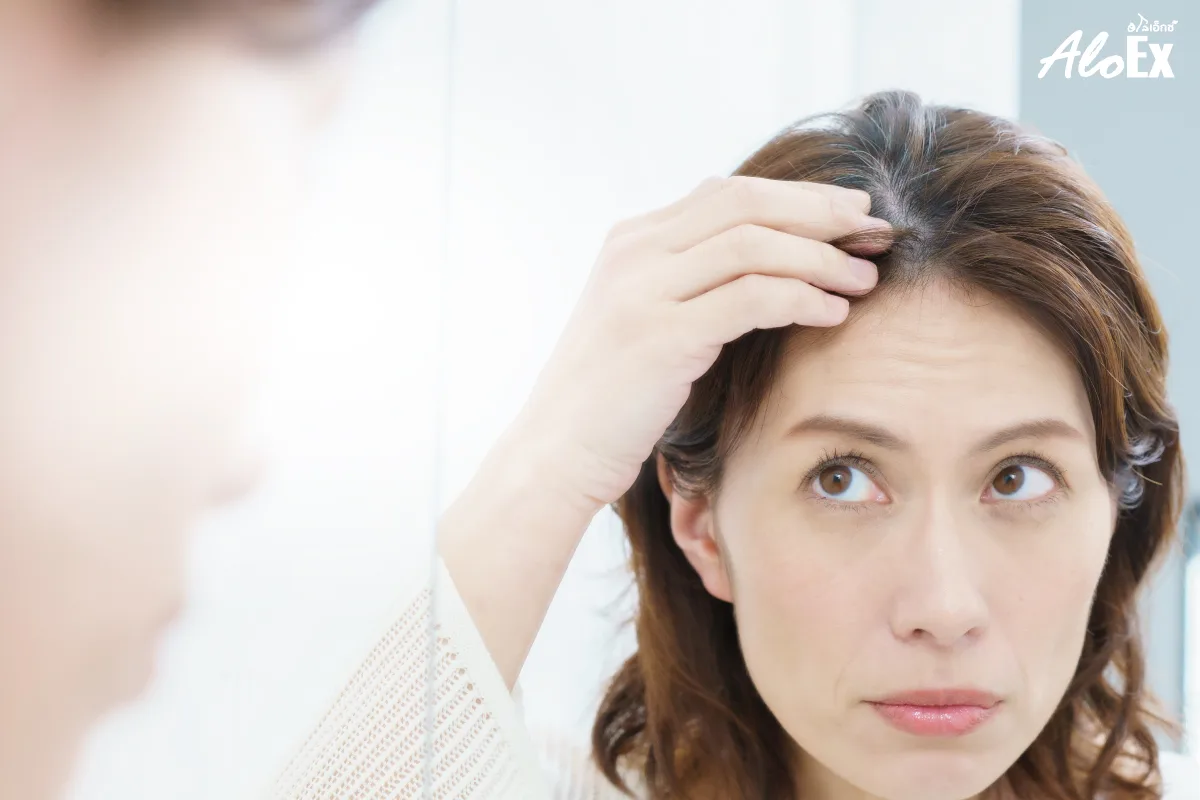
More hair than usual collected in the shower drain. A part line in the mirror that looks a little wider than it did last year, with the scalp showing through…
If that is what you are seeing, and you are a woman of 45 or over, the first thing this article wants to say is: you are not imagining it, and you are certainly not alone. For women, hair loss at this age is often not down to stress or a change of shampoo — it can be a sign of menopausal hair loss, and the driver behind it is the transition of the female sex hormones.
Below is a straightforward look at where the problem really starts, according to medical science, along with how to bring hair back to a healthier condition.

Menopausal hair loss usually begins as thinning along the centre part, not the patchy baldness men get
What is menopausal hair loss, and what actually causes it?
Menopausal hair loss is a state in which the hair's growth cycle shortens, so strands fall sooner, and the replacement hairs that grow through are visibly finer and weaker. It typically starts along the centre part and spreads outwards from there.
The real cause is not an unclean scalp — it is a loss of balance in the endocrine system, and it happens in stages:
- During the reproductive years: estrogen is high. It works like a natural fertiliser, keeping hair anchored on the scalp for longer and holding the androgens (male sex hormones) in check.
- Entering menopause: estrogen levels drop sharply.
- The troublemaker appears: without that protection, testosterone — which every body carries — is converted by the enzyme 5α-reductase into a far more aggressive hormone called DHT (dihydrotestosterone).
- The follicle shrinks: DHT binds to receptors on the follicle cells and instructs the follicle to miniaturise, so the strand is starved of nutrients and eventually falls.
Andropause vs menopause: are they different, and do they affect hair the same way?
People often assume "the change" is the same irritability for everyone. Medically, though, the male and female versions differ completely in definition, origin and hormone behaviour — across two dimensions.
Dimension 1: definition and body systems (nothing to do with hair yet)
- Female menopause
- Defined as a permanent switch-off: the ovaries stop working and stop releasing eggs entirely, with a clear cut-off point — twelve consecutive months without a period.
- Speed: a steep drop over a short window.
- Effect: the body cannot adapt fast enough, which brings hot flushes and a rapid loss of bone mass that raises the risk of osteoporosis.
- Male andropause
- Defined as a slow dimming: the testes do not shut down permanently. Instead testosterone seeps away by roughly 1–2% a year, starting from around age 40.
- Speed: so gradual that most men barely notice it, with no clear end point.
- Effect: it shows up as a decline in energy — muscle mass replaced by abdominal fat, chronic fatigue and lower libido.
Dimension 2: what it does to hair
Because the hormones behave differently at the start, what reaches the follicle looks different too:
- Men lose hair "in the open": DHT has been quietly wearing the follicles down for a decade or more, so by the time andropause arrives the follicles have miniaturised into a clearly patterned loss (male pattern baldness) — a deep M-shaped hairline, or a bald patch over the crown.
- Women lose hair "in disguise": the protective estrogen disappears abruptly, so the DHT that had been kept quiet suddenly wins out. Hair thins diffusely across the whole head (diffuse thinning), most noticeably as a widening part — but it rarely goes fully bald the way it does in men.
| Compared on | Female menopause | Male andropause |
|---|---|---|
| Medical name | Menopause |
|
| How fast hormones fall |
|
|
| Physical symptoms |
|
|
| Pattern of hair loss |
|
|

How closely is hormonal hair loss related to menopausal hair loss?
Directly related — they are the same story.
Hormonal hair loss (androgenetic alopecia) is the condition in which the follicle is disrupted by the male sex hormone testosterone until the hair's growth cycle shortens. Hair that once grew thick and strong gives way as the follicle gradually miniaturises; each new strand comes through smaller than the last, until it is little more than fine down, and finally stops growing at all.
So why can a male hormone damage the follicles of a woman going through menopause?
Because every woman's body carries a certain amount of male sex hormone from birth. In her younger years a woman's body has very high levels of the female hormone estrogen, so estrogen is the one running the game. As she gets older, estrogen falls — and during menopause it falls off a cliff, while testosterone stays where it was. The male hormone that estrogen used to keep suppressed is then free to act, engaging the enzyme 5-alpha-reductase, and that is why hormonal hair loss increases in menopausal women.
How to choose a shampoo, serum or tonic for menopausal hair loss
If you already know DHT is the main driver of your hair loss, then looking for extracts that help reduce DHT-driven hair loss is the priority. But hair and scalp problems in this stage of life are not only about hair falling: as estrogen declines, skin holds less moisture, so the scalp becomes dry and easily irritated too. With that in mind, look for products that tick these boxes.
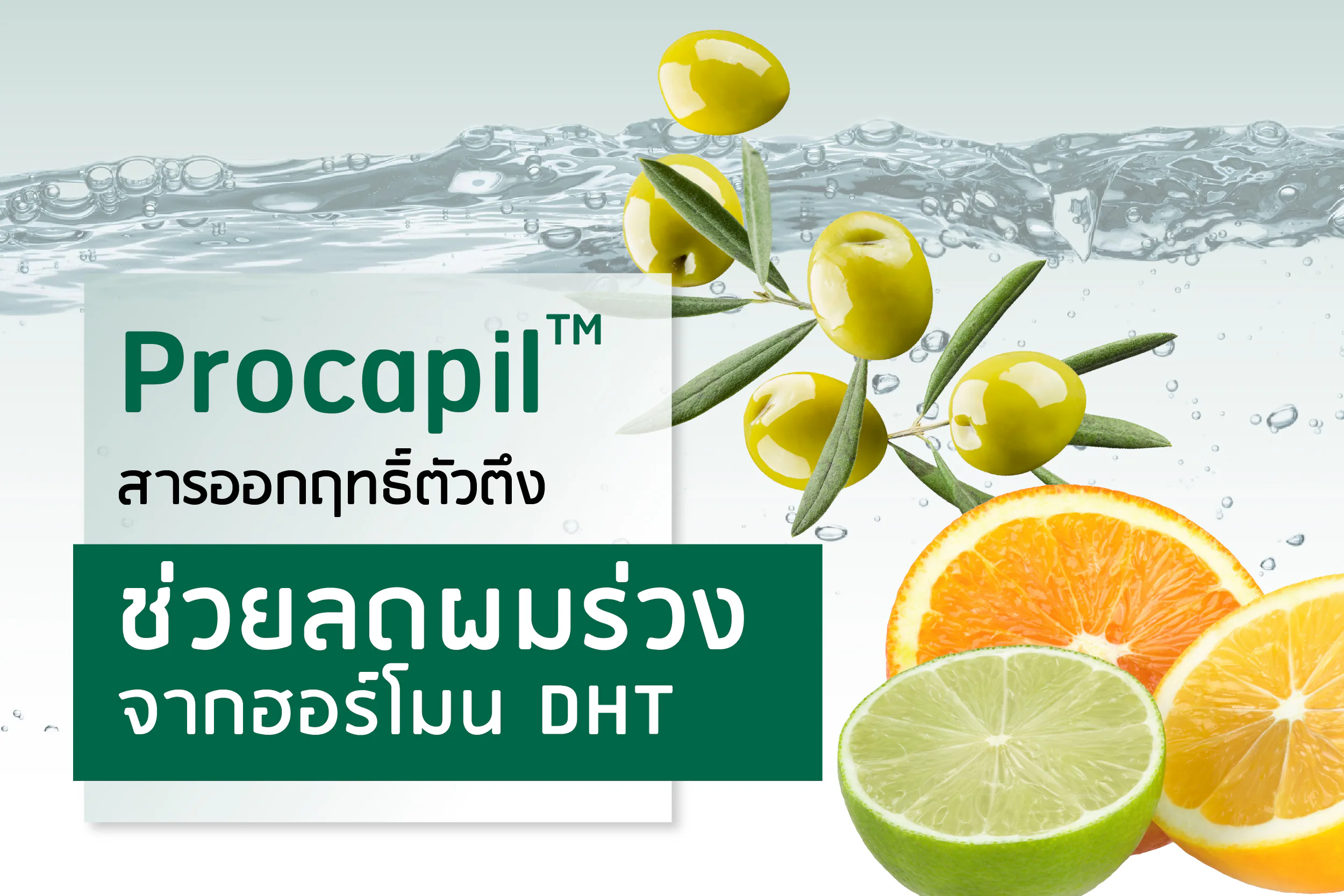
- Contains extracts that help reduce DHT-driven hair loss — for example Saw Palmetto; peptide-type extracts such as Capixyl™ and Procapil™; and specially processed natural herbal extracts such as AloEx Hydrosol Complex Extract and AloEx Phenolic Complex Extract.
- Avoids sulfate cleansers such as SLS, SLES, ALS and ALES. A menopausal scalp is dry to begin with, and sulfate cleansers strip it a little too thoroughly, leaving it drier still. An over-dried scalp is quick to itch, to react and to become inflamed.
- Silicone free. When the scalp is dry the hair goes dry and lifeless with it, and it is tempting to reach for something that adds slip. Silicone does make hair feel soft and smooth, but only temporarily — over time it builds up and blocks follicles that are already weakened, so the actives in your serum never reach the root.
- Contains extracts that help stimulate the new-growth phase. As well as helping hold on to the hair you have, a product should support new hair coming through — look for Redensyl™, AnaGain™, Apple Stem Cell, or AloEx Hydrosol Complex Extract and AloEx Phenolic Complex Extract.
- Contains extracts that add moisture back to the scalp, to make up for the natural oils and the estrogen shield that have gone. Look for soothing, water-binding ingredients such as aloe vera extract, vitamin B5 (panthenol), amino acids, or cooling herbal extracts that help bring the scalp back into balance.
- Is a gentle formula — one built around natural extracts, or carrying a mark showing it has been dermatologist tested.
Which AloEx shampoo and serum are best for menopausal hair loss?
For anyone dealing with menopausal hair loss who wants both help against DHT and real gentleness on a menopausal scalp, here is a 2-step AloEx routine — one that answers the hair problem and suits a stage of life with no appetite for anything complicated.

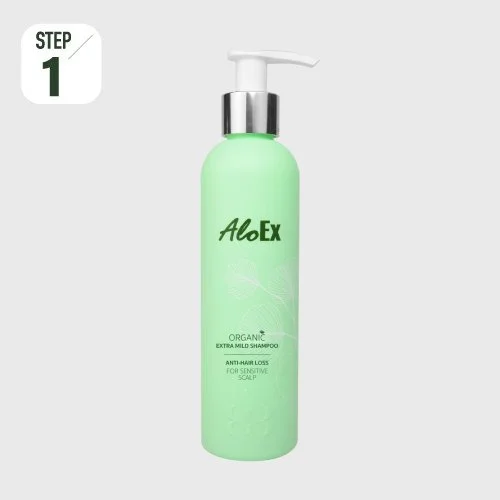
Step 1: Wash — with the gentle AloEx Organic Extra Mild Shampoo
The single most important step in caring for hair loss — ordinary hair loss or the menopausal kind — is the wash. The product may only sit on the scalp for a moment before it is rinsed away, but it is the step most likely to harm the scalp if you pick the wrong type of shampoo, and it bears directly on the scalp's moisture balance. Just as importantly, washing properly clears away what is blocking the follicles, preparing the scalp to take in the nourishment that comes next.
AloEx Organic Extra Mild Shampoo is designed specifically for people who are losing hair and have a fragile, easily irritated scalp — which is what makes it suit the menopausal stage:
- A clear, extra-gentle formula: free from irritants — sulfates (SLS/SLES/ALS/ALES), silicone, parabens and alcohol.
- Keeps the skin's moisture balance: cleans deeply without leaving the scalp tight and dry, and adds moisture back to make up for the lost skin barrier, using natural herbal extracts.
- A relaxing scent: a floral, aromatherapy-style fragrance that feels fresh as you wash — none of the grassy smell that comes with most herbal shampoos on the market.
- Powerful extracts: rich in more than 15 natural herbal extracts, tested by credible research institutes and shown to help reduce hair loss and stimulate new growth.
Read the laboratory results

Step 2: Nourish — with an AloEx water-based herbal serum, backed by scientific test results
Once the scalp is clean and the follicles are open to nourishment, it is time to feed them and shut down what is damaging the root — with a leave-in serum. This is the other key step, the one that reaches deep enough to deal with the source of menopausal hair loss.
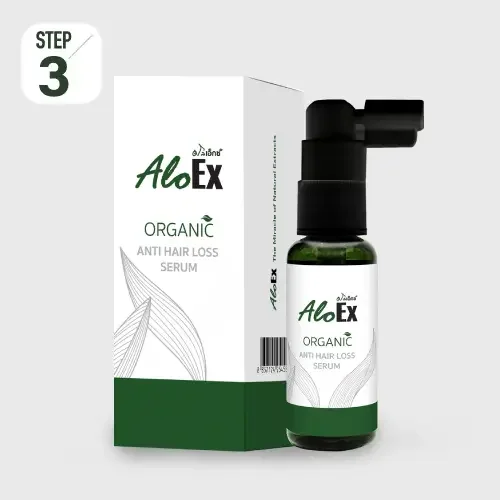
AloEx Organic Anti Hair Loss Serum is a concentrated water-based herbal serum for anyone who loves natural products but still wants results they can point to — results backed by scientific testing.
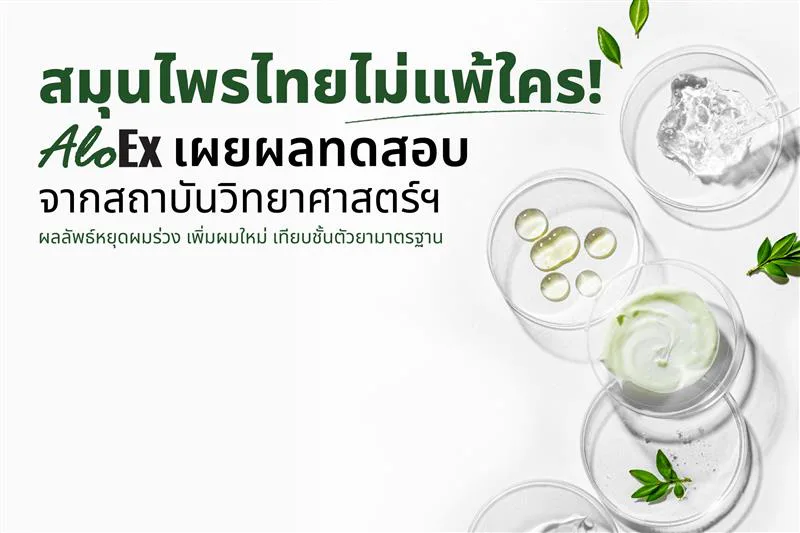
- Helps reduce hair loss, benchmarked against Finasteride: AloEx Organic Anti Hair Loss Serum contains two herbal extracts developed by AloEx — AloEx Hydrosol Complex Extract and AloEx Phenolic Complex Extract — which the Thailand Institute of Scientific and Technological Research (TISTR) tested and found to inhibit the 5-alpha reductase enzyme at 89.50% of the level of Finasteride. That result indicates the herbal extracts in the serum help both to reduce DHT-driven hair loss and to reduce the chance of DHT-driven follicle miniaturisation.
- Helps increase follicle cell division, benchmarked against Minoxidil: the TISTR results also show the AloEx herbal extracts help raise the rate of follicle cell division to 87.91% of the level of Minoxidil — the drug doctors most often prescribe for thinning hair. So beyond helping reduce hormone-driven hair loss and follicle miniaturisation, the serum also helps nourish new growth.
- Water-based, absorbs easily, no oils in the formula: a concentrated water-based herbal serum that will not flatten your hair. Spray, massage in gently, and it sinks into the scalp — you will feel the scalp a little more hydrated, with no greasy residue. Ideal for the drier scalp that comes with menopausal hair loss.
- Dermatologist tested: a menopausal scalp is quick to react, so the product has to be especially gentle. AloEx serums have been irritation tested by dermatologists and found suitable for sensitive skin.
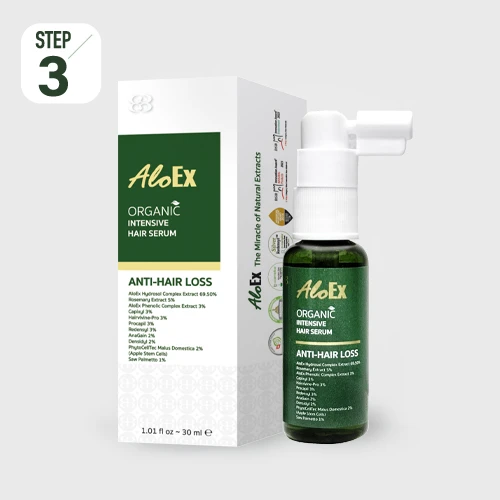
AloEx Organic Intensive Hair Serum is designed to address hair loss and thinning across several causes at once, with actives from natural sources at a 96% concentration — while staying gentle on sensitive scalps and hair.
- Helps reduce hair loss and guard against DHT-driven follicle miniaturisation: concentrated natural and herbal extracts work to inhibit the 5-alpha reductase enzyme, so it cannot pair with testosterone to become DHT — the source of hair loss and follicle miniaturisation in menopause. The actives in AloEx Organic Intensive Hair Serum that help inhibit 5-alpha reductase are AloEx Hydrosol Complex Extract and AloEx Phenolic Complex Extract, Saw Palmetto, Capixyl™ and Procapil™.
- Nourishes new growth: AloEx's own specially processed herbal extracts — AloEx Hydrosol Complex Extract and AloEx Phenolic Complex Extract — have been tested for stimulating follicle cells to build new hair, benchmarked against Minoxidil. Alongside them sit many imported extracts that help extend the hair's growth phase: Redensyl™, AnaGain™ and Apple Stem Cell.
- Light texture, absorbs fast, no flat roots: built for the hair of people with thinning specifically. The serum is water-based; massage it in gently and it leaves no oil or tackiness. You can use it daily after washing (or even on dry hair) without worrying about losing your style.
- Dermatologist tested: serious about hair loss and thinning, yet still gentle — suitable for delicate, sensitive skin, with dermatologist irritation testing to confirm it.
In summary: menopausal hair loss is not the end — it is a signal you can act on
Hair loss during menopause is the result of a hormone shift inside the body. When estrogen, which had been acting as a shield, falls away quickly, the testosterone that had been sitting quietly is free to act through the enzyme 5-alpha reductase and become DHT — the agent that miniaturises follicles and thins hair diffusely across the head, especially along the centre part.
Seen that way, the most important thing is to choose hair care that answers two things at once: helping reduce DHT activity at the source, and adding moisture back to a scalp that dries out more easily without estrogen — without harsh ingredients such as sulfates or silicone that would only make matters worse.
Two AloEx products for menopausal hair loss — covering both the source of the hair loss and gentle care for a menopausal scalp in the same routine:
- AloEx Organic Extra Mild Shampoo, a gentle formula for fragile scalps.
- AloEx Organic Intensive Hair Serum, with AloEx Hydrosol Complex and AloEx Phenolic Complex — tested by TISTR and found to inhibit 5-alpha reductase at 89.50% of the level of Finasteride and to stimulate follicle cell division at 87.91% of the level of Minoxidil — plus many imported extracts such as Redensyl™, Capixyl™ and Procapil™.
Menopausal hair loss cannot be avoided; it follows the natural change in your hormones. But care aimed at the right place helps slow it down and helps bring hair back to a stronger condition.
References
- Grymowicz, M., et al. (2020). Hormonal effects on hair follicles. International Journal of Molecular Sciences, 21(15), 5342. Read the paper
- Ramos, P. M., & Miot, H. A. (2015). Female pattern hair loss: a clinical and pathophysiological review. Anais Brasileiros de Dermatologia, 90(4), 529–543. Read the paper
- Singh, P. (2013). Andropause: Current concepts. Indian Journal of Endocrinology and Metabolism, 17(Suppl 3), S621–S629. Read the paper
- D'Souza, P., & Rathi, S. K. (2015). Shampoo and conditioners: What a dermatologist should know? Indian Journal of Dermatology, 60(3), 248–254. Read the paper